
Dental 2000 gains control of its service operations with Handyman and Uniconta
Better service history, smarter scheduling and faster invoicing help Dental 2000 run a more efficient service operation – while enabling dental clinics to get help faster when critical equipment breaks down.
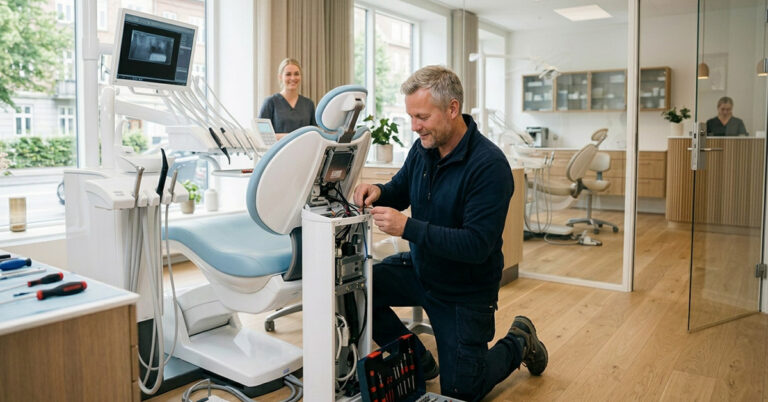
When a dental clinic calls because a compressor or suction unit has stopped working, there is no time for lengthy planning. If critical equipment is down, the clinic can quickly lose both time and revenue. For Dental 2000, this makes fast response, efficient scheduling and access to the right information essential.
To support its service operations, Dental 2000 uses Handyman integrated with the Uniconta ERP system. Together, the two systems create a connected workflow – from scheduling and documentation to invoicing – making it easier to stay in control of a busy service operation.
At a glance
About Dental 2000
- Provides service to dental clinics across large parts of Jutland, Denmark
- Sells and maintains dental equipment
- Handles both planned maintenance and urgent breakdowns
The solution
- Handyman Field Service Management
- Integration with Uniconta
- Digital scheduling
- Complete equipment service history
- Material registration
- Photo documentation
- Faster invoicing
When a clinic is down, every minute counts
Dental 2000 works with equipment that dental clinics rely on every day. This includes treatment units, autoclaves, compressors and suction systems – equipment that can be critical to keeping a clinic operational.
“If a critical piece of equipment breaks down, the entire clinic can potentially come to a standstill. That means we need to be able to respond quickly,” says Tommy Bøjstrup, owner of Dental 2000.
The company therefore combines scheduled service visits with urgent call-outs. Managing both at the same time places significant demands on scheduling.
“We obviously have many planned service jobs, but an important part of our business is also being able to respond quickly when something breaks down,” says Tommy Bøjstrup.
Technicians plan their own work – without losing the overview
At Dental 2000, scheduling does not only happen in the office. Technicians manage a large proportion of their urgent jobs themselves, while the office uses Handyman Office to schedule planned service visits, maintenance and other work.
For Dental 2000, this combination works well.
“It is much easier for us to see what is happening in our calendars and make better use of the available capacity,” says Tommy Bøjstrup.
Handyman also makes it possible to reuse service plans across similar installations. This is particularly useful for Dental 2000, as the company often services the same types of equipment at multiple customer locations.
“We can now create one basic service plan with materials, hours and descriptions and link it to all the relevant equipment. If the manufacturer changes something, I only need to update it in one place. Over time, that is going to save us a lot of time,” says Tommy Bøjstrup.
Service history makes the difference
If Tommy Bøjstrup had to highlight just one Handyman feature, he would not hesitate: The service history.
Every piece of equipment is registered in the system, and each service visit is linked to the relevant installation. This means that any technician can quickly see what work has previously been carried out.
“The service history has been a huge help. It makes troubleshooting faster and conversations with customers easier. Several of our technicians may work for the same customer, and now we can immediately see what the previous technician did.”
The history also makes it easier to identify recurring problems.
“Some faults return after a few months. We can then go back and see exactly what was done previously. That makes it much easier to identify the underlying cause.”
Results
- Better overview of scheduling
- Complete service history for all equipment
- Faster troubleshooting
- Less capital tied up in inventory
- Faster invoicing
- Better documentation
Documentation becomes part of the service process
Dental 2000’s technicians already register working hours, materials and job descriptions digitally. Photo documentation has also become a natural part of their daily work.
“We use photos a lot. They remove uncertainty because we can document exactly what things looked like.”
The next step is digital service reports and checklists. Today, these are still completed on paper, but that is about to change.
“The reports will then be stored together with the service history, and the customer can receive them straight away.”
For Tommy Bøjstrup, this is about more than eliminating paper. The real value lies in having all relevant documentation in one place.
“We get all the documentation together, and the customer receives it electronically right away. It will make everything much easier.”
Better visibility means less capital tied up in inventory
One of the benefits that has surprised Tommy Bøjstrup most is not directly related to the technicians. It is about inventory. With upcoming service jobs planned in Handyman, Dental 2000 has much better visibility into which spare parts and materials will be needed in the weeks ahead.
“I can now see which service jobs we have coming up over the next month and order the parts accordingly.”
As a result, the company does not need to keep as much stock on the shelves.
“In many areas, I have been able to reduce the amount of capital tied up in inventory. I have a much better idea of what we need and when we need it.”
From completed job to invoice – faster
When a technician completes a job in Handyman, the relevant data is transferred to Uniconta, where it can be used for invoicing immediately. Previously, completed jobs could wait until someone in the office had time to process the invoice. Now, working hours, materials and other relevant information are already registered and ready to go.
“We can send our invoices straight away. It makes a significant difference to our cash flow.”
One step at a time
Although Dental 2000 is already seeing tangible benefits, Tommy Bøjstrup believes there is still significant potential ahead.
The company has deliberately chosen to implement Handyman gradually. The first priority was to get scheduling, material registration and job descriptions working smoothly. Digital service reports and checklists are next.
“We are building it up step by step. That way, we become good at one thing before moving on to the next.”
He is particularly looking forward to having all service documentation available digitally in one place. But even at this stage, his conclusion is clear:
“There are many small areas where we are saving both time and money.”